Can grazing make more money than row crops?
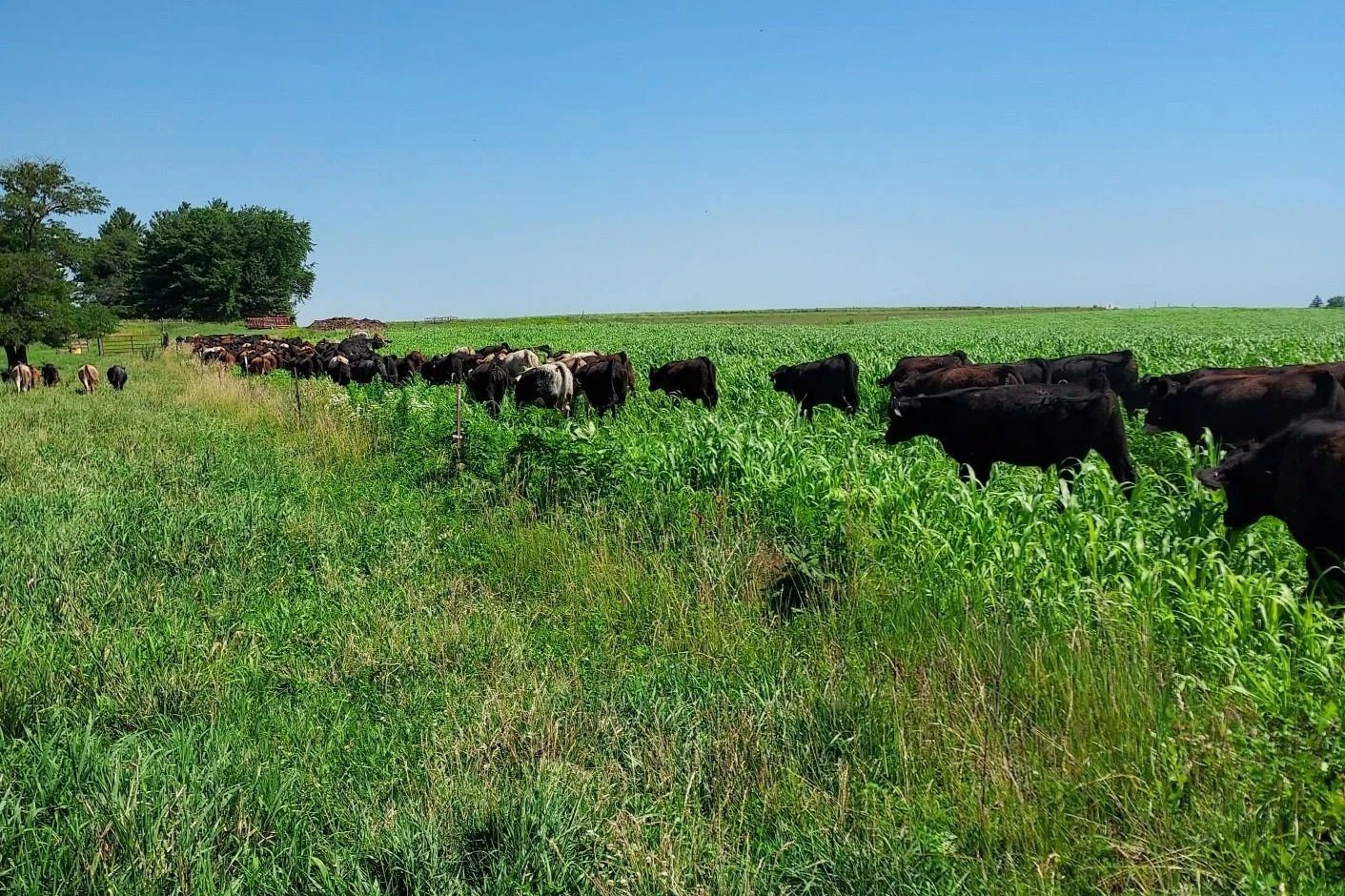
Trevor Toland is a vocal advocate for regenerative farming practices. The Macomb producer teased a big announcement for his River Oak operation in April 2025 that would “empower” his beliefs into action.
Profitability
Can grazing livestock in ‘good black dirt’ be more profitable than row-crop production? Trevor decided to find out.
After considering grain markets and input costs, he announced his decision to use 63 acres of previous row-crop land for custom grazing, managed by new lessee Carson Welsh. The new venture would be added to the 265 acres of permanent pastures that currently runs 100 cow-calf pairs, half on reed canary grass and half on fescue and red clover.
“I have often talked about being able to match or exceed row-crop profit with regenerative grazing and expert management on marginal land, but never on good black dirt,” Trevor wrote in his AgriNews column in May, with promises to track and share his results.
Monthly Progress
The cropland was already fenced since Trevor had previously grazed cattle on cornstalks in those fields. Access gates, temporary fencing, and water access were planned that would allow up to 300 6-weight calves to graze through 20 paddocks.
At least, that was the plan.
In May, the new ground was seeded with a sorghum sudangrass mixture using a no-till drill directly into the dry-soil corn residue. After a warm start, temperatures dropped into the 40s at night which slowed growth.
In June, 245 700-pound custom calves arrived (a little earlier than originally planned) and were temporarily placed in the lush reed canary grass permanent pasture.
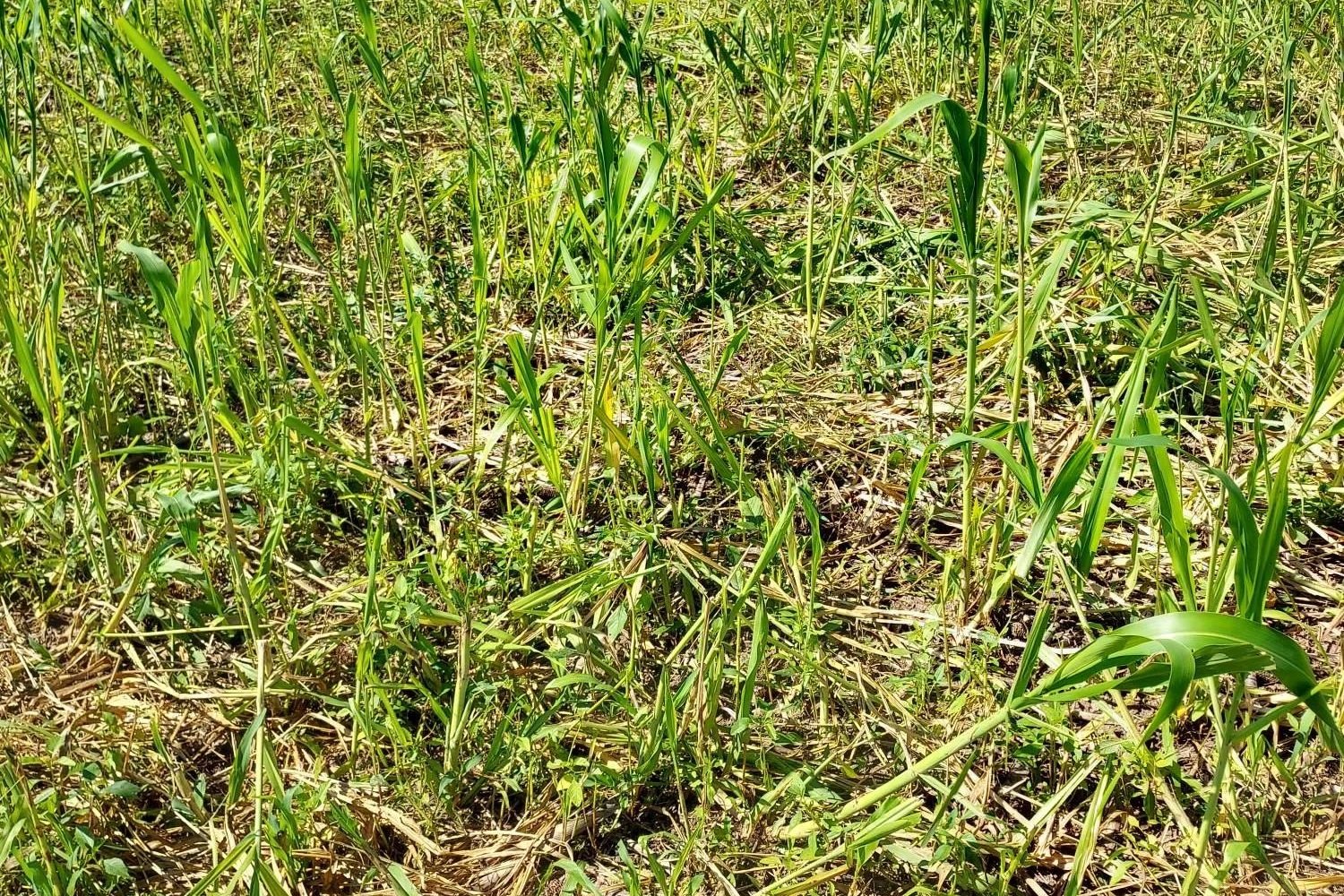
By July, the forage was taller than desired, though somewhat uneven, likely due to the no-till planting, heavy early rainfall, and cooler nights that spring. Trevor and Carson were concerned with the high percentage of trampling in some spots.
The team experimented with various paddock sizes and stocking rates using temporary fencing, dividing the group into two or three groups instead one large group.
“As the group stands or finds shade or water, it does not take long for the 245 to wipe out forage in that location,” Trevor says. “It reminds me to never favor mob grazing, at least in this part of the world. We have to just keep looking for the best practices.”
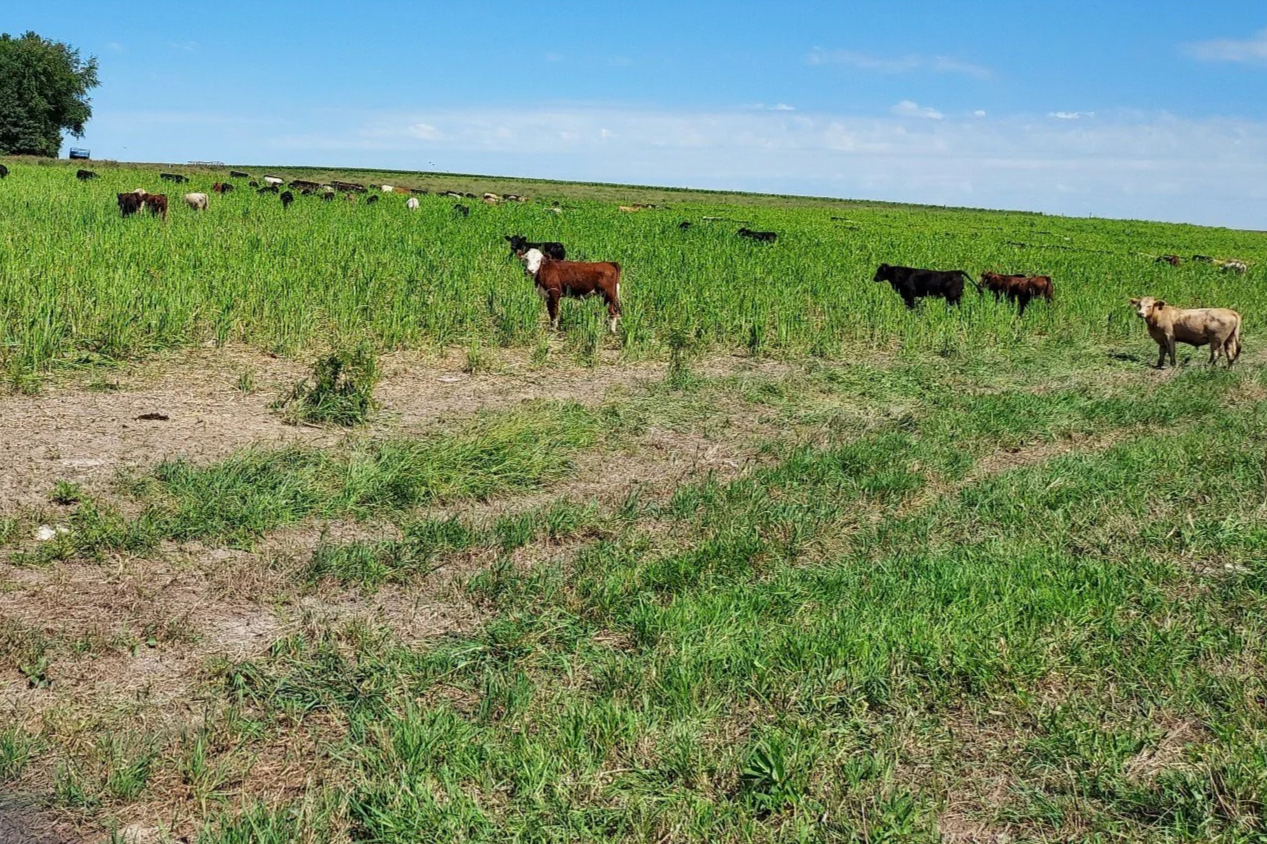
By August, Trevor said that the challenges were easing; steers were less anxious in their second rotation. Lessons were learned from the first rotation, and they adjusted the daily acreage.
“We needed to use less than the four acres per day that we achieved in the first rotation,” Trevor said. “I calculated that at 16,000 pounds of dry matter available in the four acres and consumption at 3% and a total of 5,500 pounds per day, we were using about 35% of the growth. That 65% trample figure is somewhat high. Cows would eat a lot of the trample, but stockers not so much.”
By September, the steers were grazing the former cropland for the third time. August’s lack of rain provided less regrowth of the sorghum-sudangrass than after the first and second graze. To balance the diet, they fed 6 to 8 pounds of distillers per day and provided access to round bales of grass hay.
Steers began to be sold off as they became ready.
After the third rotation, they no-tilled cereal rye and kale into the sorghum-sudangrass stand, though dry soil impacted germination. “It is the worst situation we have been in this time of year since I took over the management of River Oak in 1969,” Trevor says.
In mid-October after a heavy frost, the potential of prussic acid poisoning ended the sorghum-sudangrass grazing just as the remaining steers finished the final paddock for the fourth time. Those steers were moved to a sacrifice paddock until sold.
Our results showed a profit
“In all, considering the dry summer and our inexperience, we feel this was a pretty successful start for this practice,” Trevor says.
"In a year most row crop producers lost money on a per acre basis and struggled to breakeven, our project earned a profit and demonstrated the economic competitiveness of grazing stocker cattle on farmland.”
Calculating the bottom line
Using data from Illinois farmdoc, adjusted for actual previous cropland performance “the competition for farmer return per acre is not very formidable,” Trevor says.
Soybeans after corn could have returned a negative -$57 per acre.
Corn after corn could have returned a negative -$141 per acre.
Breakeven prices to cover for soybeans after corn were $6.91 for non-land costs and $10.51 for non-land and land costs.
Comparing costs for producing and grazing sorghum-sudangrass with stockers:
The expenses (seeding, seed, fertilizer, clipping, machines, land use, supplemental feed, and miscellaneous) totaled $387.62 per acre.
The crop revenue from daily custom charges and gain bonuses was $445.63 per acre, which made a return of $58.01 per acre to labor.
A total of 18,865 grazing units accumulated over 77 days in the 63.5 acres or 297 grazing units per acre.
Four rotations were completed from June 25 to Oct. 20, but of that 118 days only 77 were in the sorghum/sudangrass. Steers were in other paddocks in the other 41 days.
Aha Moments
245 head of 7-weight steers can make a lot of footprints in small acreages; can leave a lot of cattle trails, even though in an area for a short time; can leave areas close to water or shade completely barren in a short time; and are still causing quite a bit of trample.
In a year when most row crop producers struggled to breakeven, our project demonstrated a per acre profit with our revenues exceeding associated expenses.

2026 Improvements
Small changes can increase profit in 2026.
The cereal rye and kale will be grazed in the spring before a new sorghum/sudan seeding.
The stocking rate will be lowered to make it possible for cattle to remain on the crop ground 100% of the summer.
More shade will be provided with closer access to water.
Higher quality of placements will enhance potential gain.
An enhanced crop mix is needed to cover more ground space and reduce walking and trampling. Clipping may only be necessary for looks.
Source: Trevor Toland’s observations were highlighted monthly in his column in AgriNews. This recap includes much of his own words, edited by ILGLC content manager Judy Bingman.