Restoring prairie in ‘the prairie state’
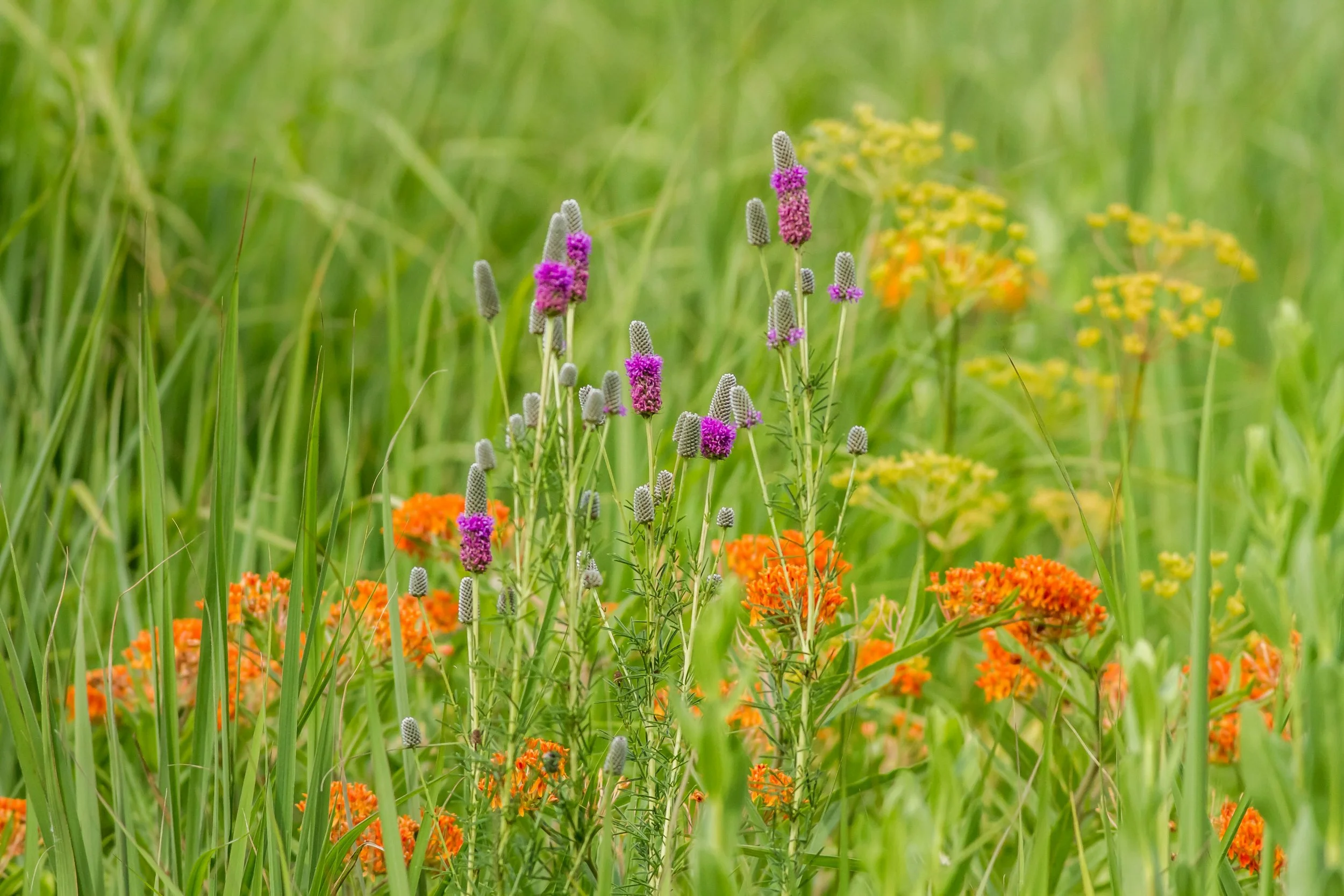
The colorful diversity of plant species is preserved in the restored Schulenberg Prairie at the Morton Arboretum. Photo by Dulcey Lima on Unsplash.
It’s nearly impossible to find prairie in “The Prairie State.”
Two Illinois researchers, Jeffrey Matthews and Jack Zinnen, have been on the hunt for the illusive plant species of our past. RELIX, their database of plant species uncovered from historic prairies, includes nearly 37,000 plant records from 353 prairie remnants across eight Midwestern states.
Glimpses of tallgrass prairies, remnants left undisturbed for centuries, are disappearing. In a recent Illinois College of Agricultural, Consumer, and Environmental Sciences article by Rami Jameel, numbers tell the story.
“Only 1% of tallgrass prairie across Illinois, Iowa, and Wisconsin has survived. Their future depends on intentional plantings, whether that’s in nature preserves, gardens, or nature strips along roads and highways.”
Our History
1600s French explorers were amazed by the “sea of grass” they encountered in America’s midsection. At that time, 61% of Illinois was covered in prairie, the rest covered in forests.
The first farm settlers arrived between 1820 and 1840. The self-cleaning moldboard plow changed the prairie landscape by allowing the deep disruption of the thick prairie sod, according to the US Army Corp of Engineers in Tallgrass Prairie.
“By 1900, most of the prairies had been converted to agriculture or urban uses,” the authors say. “By 1976, 39 of Illinois’ 102 counties had no high-quality prairie remaining and of those counties with high-quality prairie, 28 contained five or less acres.”
Why prairies matter
“A healthy prairie ecosystem is a wonderful example of interdependence functioning at its best. The plants have adapted to the harsh climate. The animals have adapted to the plants. As a whole, the prairie functions as a single living entity — ecosystem — composed of many parts. When a part is removed, many other parts run into problems. … Biodiversity and interdependence go hand in hand, and the health of the ecosystem relies on them both.” Tallgrass Prairie
Restoring grasslands
Sustainable practices can rebuild soil health that leads to restoring a self-sustaining prairie ecosystem. Matthews and Zinnen have provided a guide to the plant species available for recovery, historical plant species with deep roots to allow pathways for water flow, the flexibility to withstand strong winds, and survival mechanisms to regrow after fires.
“Human survival is threatened by a breakdown in ecosystems,” the authors of Tallgrass Prairie warn. The loss of shelter, food, fiber, and medicines today — and yet to be discovered — will have consequences for humans, as well as microorganisms, fungi, insects, birds, and mammals.
“Balance between human needs and ecosystem sustainability is essential,” they conclude.
In the notes section of the database, Jack Zinnen provides a sad acknowledgment of the collection:
“Anyway, enjoy, and long live the tallgrass prairie, a wonderful sea of beauty poisoned by the salts of wanton destruction.”
Identifying Prairie Grasses
About the video: The Which Grass is Which series focuses on the identification of 18 species of grasses that can be found in Illinois prairies. Prairies are dominated by grasses, and what a diversity of them there is! We’ll start to piece out the different species in this session.
For more information
Download the Tallgrass Prairie publication.
Download the RELIX database.
Resources
Illinois plant ecologists fight to restore Midwest biodiversity, Illinois ACES
Tallgrass Prairie, US Army Corp of Engineers
RELIX: A Dataset of Vascular Plant Species Presence for 353 Prairie Remnants in the Midwestern United States, with Prairie Remnant Metadata, Jack Kinnen, Marissa H. Chase, Brian Charles, Justin Meissen, Jeffrey W. Matthews
Illinois Data Bank, University of Illinois Library