Prevent damage from alfalfa weevil
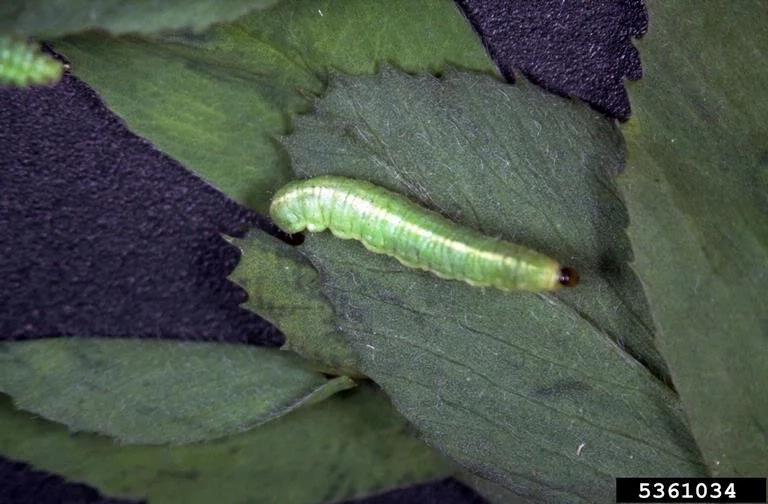
Image: Frank Peairs, Colorado State University, Bugwood.org
The alfalfa weevil is small, but its damage could reduce yields by 10 to 15% and decrease forage quality.
Identification
Alfalfa weevil adults are brown snout beetles and have a dark, narrow stripe which extends down the back. They measure ¼ inch in length. They insert yellow eggs into the alfalfa stem. Their larvae are yellow-green with a white stripe down the middle of the back and two fainter stripes on each side. The larvae have a black head. They transform to adults in a white cocoon about the size of a pea.
Life Cycle
Weevils become active in March or early April in Illinois. A female weevil insert clusters of 2 to 25 eggs inside alfalfa stems. By June, larvae are easily observable. They feed for three to four weeks and molt their skins three times. Then, they spin their cocoons on plants or fallen leaves.
When the adults emerge, they eat for one to two weeks before retreating to a more sheltered area. They are inactive during summer. In cold weather, they move to the top of alfalfa plants or to protected woodland or ditches to overwinter.
Damage
Damage occurs from both adults and larvae, but the larvae cause the majority of the damage. Larvae feed initially on the inside of terminal leaves and later move to foliage on the lower portion of the plant.
Damage first appears as pinholes in leaf terminals. As the larvae grow, leaves become skeletonized. “Third and fourth instars defoliate plants by feeding between the veins and also on the buds and growing tips. Adults generally feed on the leaf margins which creates a feathery appearance of the foliage. Injured leaves dry very quickly giving the field a grayish to whitish cast.” (University of Illinois Extension, U of I Department of Crop Sciences)
Damage can be extreme to first cutting of hay in Illinois. Southern Illinois may experience significant egg lay during the fall with damage noted the following spring. In Northern Illinois, damage is more likely to occur if the first harvest is delayed.
Alfalfa weevil activity can be predicted with the use of degree-days.
Beginning January 1, the accumulations of degree-days (base 48°F), can be used to estimate alfalfa weevil activity.
Illinois generally experiences two larval peaks, one from fall-laid eggs and a second from spring-deposited eggs.
Larvae begin to hatch around 300 degree days. We recommend beginning scouting after the accumulation of 250 to 300 degree-days. The first larval peak is estimated to occur after the accumulation of 325 degree-days and the second larval peak after 575 degree-days.
Management
Follow this management advice from University of Illinois Extension.
“Harvesting the crop early, when alfalfa weevil populations are high, is the most common and cost-effective way to dramatically reduce weevil densities. This helps to remove food and shelter from larvae and also increases their exposure to harmful rays from the sun. Reports indicate that harvesting can reduce pest populations by 95-98%. The windrows of hay also create a suitable environment that allows for the development and spread of the fungus Zoophthora phytonomi.
“Alfalfa weevil populations may be regulated by naturally occurring pathogens.
As you scout your alfalfa fields, keep alert for brown or discolored larvae on leaves at the top of plants. These larvae may have been infected by a fungus, Zoophthora phytonomi. The fungus reduces larval populations during the summer, subsequently resulting in a smaller overwintering population of adult weevils.
Zoophthora phytonomi is favored by a warm and humid environment. With above average rainfall or humidity levels above 90%, an environment may be present in which the fungus can develop and cause a dramatic decline in alfalfa weevil populations.
“Parasitic wasps also help keep alfalfa weevil populations in check.
Bathylplectes anurus and B. curculionis are two parasitic wasps that have been introduced into the United States. Both wasps are very small, about 1/8 inch, and deposit eggs in weevil larvae. Adult female wasps lay their eggs in weevil larvae. The parasitoid larva, following hatch, kills the weevil as it completes its cocoon. A brown cocoon with a white band is formed by the parasitoid.
The parasitoid cocoon may be found in the cocoons of the alfalfa weevil, and these parasitoid cocoons appear to "jump" several centimeters when disturbed.
“Early harvesting is a very effective tool for the management of the alfalfa weevil.
“There are several insecticides registered for the control of alfalfa weevil. In recent years insecticide use in alfalfa has decreased. Biological and cultural control practices often keep alfalfa pests below economic levels. Monitoring of alfalfa fields for insect pests and crop development will help determine the need for management strategies.”
Alfalfa Weevil
The alfalfa weevil is one of the primary insect defoliators of alfalfa. Read how to identify and manage alfalfa weevils from the University of Illinois Extension.
Source: Alfalfa Weevil, University of Illinois Extension Field Crops
Editor: Judy Mae Bingman, Illinois Grazing and Forage Hub Coordinator