Follow the clues to better forage quality
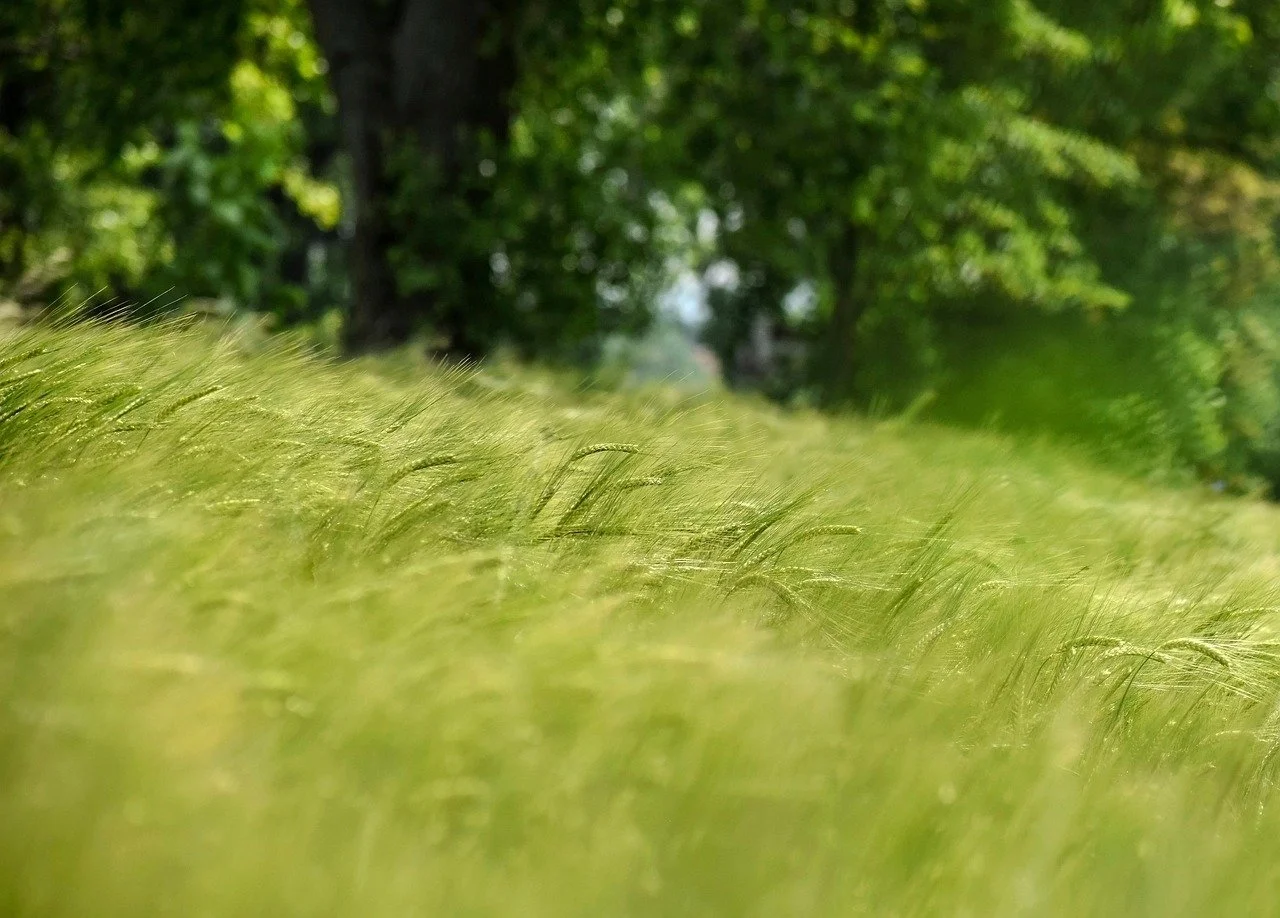
Forage quality is key to providing the nutrients grazing livestock need. Three factors impact forage quality: plant species, plant maturity, and plant part.
In general, legumes carry higher quality values than grass species, according to the USDA National Resources Conservation Service. Protein value decreases and fiber content increases as the plant grows from the leafy stage to the stem stage. Plant leaves contain more protein than stems; thus, higher quality as a livestock forage.
Understanding the terms
When analyzing forage quality, it’s best to understand the terminology. The following definitions are copied from the Illinois Grazing Management Fact Sheet.
Crude Protein (CP) in forage is the total amount of protein, some of which is insoluble or nondegradable.
Crude protein measures only the nitrogen content of the feed. The nitrogen contained as “amino acid nitrogen” or “non-protein nitrogen” is not distinguished.
The value is obtained by multiplying the amount of the nitrogen in the feed by 6.25. The value comes from the fact that most protein contains about 16% nitrogen (16 / 100 = 6.25).
Degradable Intake Protein (DIP) is protein that is broken down in the rumen, mainly into ammonia. Most rumen microbes need ammonia to maintain adequate microbial growth.
Undegradable Intake Protein (UIP) is the protein fraction also referred to as bypass protein. UIP is resistant to rumen microbial degradation and therefore bypasses the rumen. Most UIP can be broken down.
Soluble Protein (SP) is protein that is degradable in the rumen very rapidly. Soluble protein is converted to ammonia in the rumen within minutes of being ingested. The remainder of the degradable fraction may take hours to be broken down.
Neutral Detergent Fiber (NDF) is an estimate of the portion of a forage sample consisting of the walls of the plant cells.
The estimate is determined by boiling a forage sample in a neutral detergent and weighing the residue. Boiling removes the soluble components of the cell — most of the sugars, fats, starches, and proteins. The remaining residue is made up of plant cell walls composed mostly of cellulose, hemicellulose, and lignin.
The amount of NDF residue is negatively related to forage intake, so high quality forages have low amount of NDF.
Acid Detergent Fiber (ADF) is considered the indigestible portion of a forage sample. Measurement of ADF is similar to NDF except that a forage sample is boiled in an acidic detergent.
The boiling process, with the detergent, removes sugars, fats, starches, and protein, but removes hemicellulose as well.
The amount of ADF residue is negatively related to energy, so high-quality forages contain low amounts of ADF.
Total Digestible Nutrients (TDN) is an estimate of digestible forage. TDN is not measured directly but is calculated from ADF.
TDN is used by many beef producers to balance rations.
Net Energy (NE) is calculated from ADF.
Net Energy (NE) estimates are used largely by dairy producers in ration balancing for maintenance (NEM), gain (NEG), and lactation (NE1).
Relative Feed Value (RFV) is an estimate of hay and forage quality. Calculations are from NDF, and ADF, with primary emphasis, on NDF.
The average or reference RFV equals 100.
Higher scores denote higher quality and lower scores denote lower quality.
Digestible Organic Matter (DOM) is the percentage of energy and protein in forages expressed as organic matter intake.
Digestible Dry Matter (DDM) or digestibility is determined in several ways.
Estimated mathematically from ADF, the higher the ADF, the lower the digestibility.
Digestibility is also measured chemically, sometimes measured with actual rumen fluid and other times measured with laboratory enzymes.
Dry Matter Intake (DMI) can be determined with feeding trials. Usually intake is simply estimated from NDF. The higher the NDF, the lower the intake.
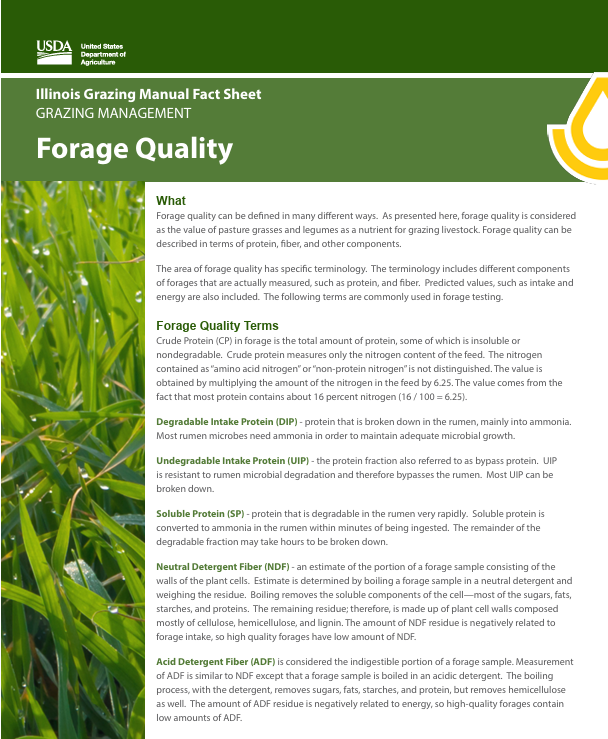
Illinois Grazing Manual Fact Sheet
GRAZING MANAGEMENT
This work was created as a collaboration USDA, Illinois Extension, Illinois Department of Agriculture, and the Illinois Grassland Conservation Initiative,
Check out the Year-Round Grazing Management Plan from USDA NRCS.
Sources: USDA, Illinois Extension, Illinois Department of Ag, and the Illinois Grassland Conservation Initiative.
Editor: Judy Mae Bingman, Illinois Forage and Grazing Hub Coordinator