Managing broomsedge in pastures
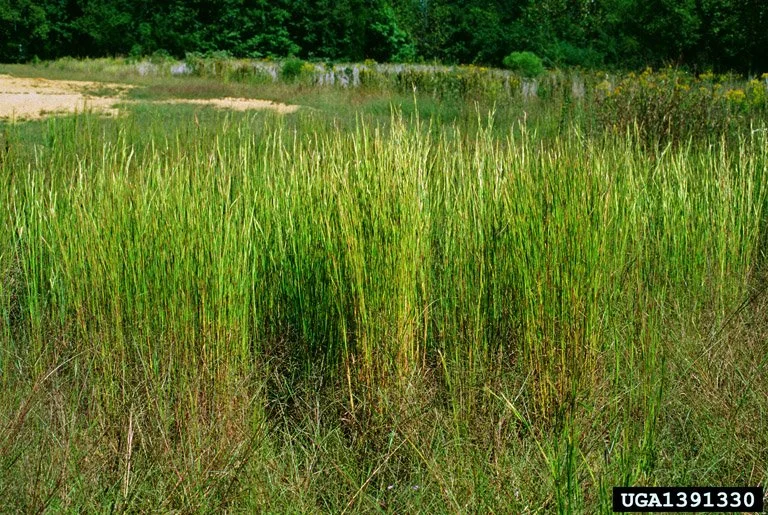
John D. Byrd, Mississippi State University, Bugwood.org. Licensed under a Creative Commons Attribution 3.0 License.
In spring, forages need time to reawaken from winter before they are grazed. Spring is a good time to evaluate your pasture and hay fields for weeds.
Some weeds are easily managed, others will require herbicide for control. If the weeds don’t taste good to livestock, they’ll pass over them and overgraze forages they like better.
Broomsedge can be one of those problematic weeds.
“While broomsedge is a native plant, it is also a weedy grass commonly found in pastures and hay fields,” says Teresa Steckler, Illinois Extension commercial ag specialist. “Broomsedge is not a highly competitive species, but rather an opportunistic native plant that takes advantages of situations that decreases competitiveness of desirable forage plants.”
It thrives in fields with poor soil fertility and inadequate grazing pressure, Steckler says. Nutrient-depleted soils or highly acidic soils limit the ability of good forage plants to grow, opening the gate for weeds like broomsedge to grow rapidly.
“Inadequate grazing or defoliation pressure during the beginning of the growing season for broomsedge can also favor this plant,” Steckler says. “Cattle will actively graze it when it is producing young vegetative growth. Early in the growing season, it is quite palatable and continued defoliation at this stage will help decrease plant vigor.”
When allowed to mature, though, broomsedge is not palatable to cattle, so it grows unchecked.
Management
“It’s rare that you find broomsedge, a warm-season perennial grass, in a pasture or hayfield that has been well-managed for multiple years,” says Mike Rankin, Hay & Forage Grower managing editor. “It generally only grows where the population of desirable forage plants is low, or the preferred forage crop is unthrifty because of low soil fertility.
“In other words, broomsedge exploits the misfortune of other species.”
Management begins with understanding what’s happening in the soil, and that is best determined by testing the soil. Learn to take samples and where you can send them on Illinois Extension’s soil website.
“Generally speaking, if your fields have a significant coverage of broomsedge you will likely find that you are missing two key nutrients — phosphorus and calcium carbonate (lime),” Steckler says. “Experience tells me that most of the time, phosphorus is low in these fields.”
Overgrazing of desirable forages also favors broomsedge.
“You need to remove cattle at strategic times, especially during the summer months so the forage species can grow in late summer and fall,” says Steckler. “F.J. Crider in 1955 showed that when more than half of the forage is removed from a plant, root growth stops within the first day or two afterwards.”
Steckler says that root growth stops from 6 to 18 days, (11 days on average). “If cattle graze more than half of the top growth of a grass, at an interval less than 11 days, the roots never get to recover.”
If the roots don’t recover, then neither will the top, and that provides the opportunity for broomsedge to take over.
Evaluate if the tall fescue stand needs to be thickened.
“If the tall fescue stand is thin, there may not be enough plants to cause competition to the broomsedge,” says Gary Bates, University of Tennessee Beef & Forage Center director. “If you have a 50% or more stand, you may need to simply drill more tall fescue in the fall to thicken the existing stand. If the stand is less than 50%, it may be best to spray and kill everything (including the broomsedge) and replant tall fescue in the fall.”
Steckler offers additional suggestions for broomsedge management.
Clip broomsedge in late summer or early fall once just before it produces seed to reduce shading of desirable forage species, making them more competitive in the stand.
Apply 60 lb N/A after we clip pastures in late summer to stimulate desirable cool-season grasses to shift the forage composition away from broomsedge.
Kill the existing the pasture with nonselective herbicide and reseed it after improving soil fertility and grazing management (an expensive method).
Feed hay on broomsedge-infested pastures as a low input way of increasing soil fertility over time by utilizing the nitrogen, phosphorous, and potassium (approximately 50, 15, and 60 lbs. per ton, respectively) found in the hay.
Pastures don’t get in a poor condition overnight and they will not be fixed overnight either.
Controlling undesirable plants in pastures and hayfields will require a sustained effort of improving both soil fertility and grazing management.
Source: Teresa Steckler, Illinois Extension Commercial Ag Specialist
Source: Gary Bates, University of Tennessee Beef & Forage Center Director
Editor: Judy Bingman, Grazing and Forage Hub Coordinator
Reference: Broomsedge in pastures, Illinois Extension
Reference: Forage management: Getting rid of broomsedge, UT Beef and Forage Center
Reference: Broomsedge is talking: Are you listening, Hay & Forage Grower