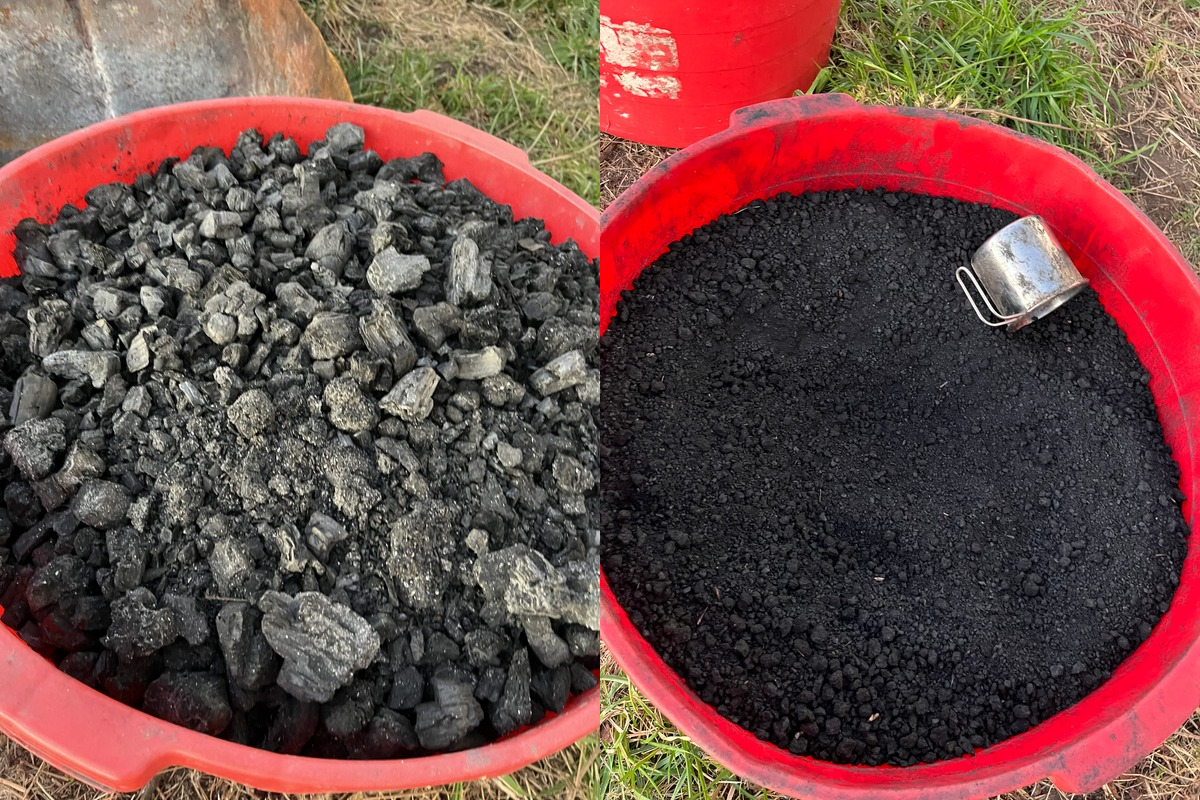
Brett Mathews and his wife, Emily, hosted a pasture walk in early November at their Dividing Ridge Farm near Liberty where they discussed their experimentation with biochar. It takes about four hours per batch to heat in a kiln. Brett says he uses a small amount, only a few cups, per load of manure. Mixing the biochar into the manure is important because microbes need to activate it. It has potential applications in improving soil structure, water retention, nutrient cycling, and long-term carbon storage. Image by Jacob Hamilton.
There’s a lot to unpack about biochar.
What is biochar?
Biochar is a stable, carbon-rich material made by heating organic biomass in a low-oxygen environment, a process called pyrolysis. The low-oxygen level causes the matter to decompose rather than combust.
Biochar resembles charcoal and comes in various forms depending on the biomass source and the temperature and length of heat used during pyrolysis.
How is biochar made?
A variety of organic matter can be used: plants, wood, manure, crop residues, and other agricultural wastes. The higher the lignin content, as in woody materials or nut shells, the greater the amount of biochar produced.
“The biomass decomposes to smaller molecules of gas and solids,” says Marion Murray, IPM project leader at Utah State University Extension. “When cooled, some gases condense to become biofuel while the remaining stays in gas form (syngas).
“The solid (mainly the lignin portion of the biomass) becomes biochar. More biofuel is created during “fast pyrolysis,” where the pyrolysis heating rate is high and the starting feedstock is finely-ground. Conversely, during “slow pyrolysis,” which uses longer, slower heating rates and larger pieces of feedstock, more biochar is formed.”
Many people use kilns to heat the biomass, using temperatures from 350° C to 700° C (662° F to 1,292° F) depending on the organic material used and its intended purpose as biofuel or biochar.
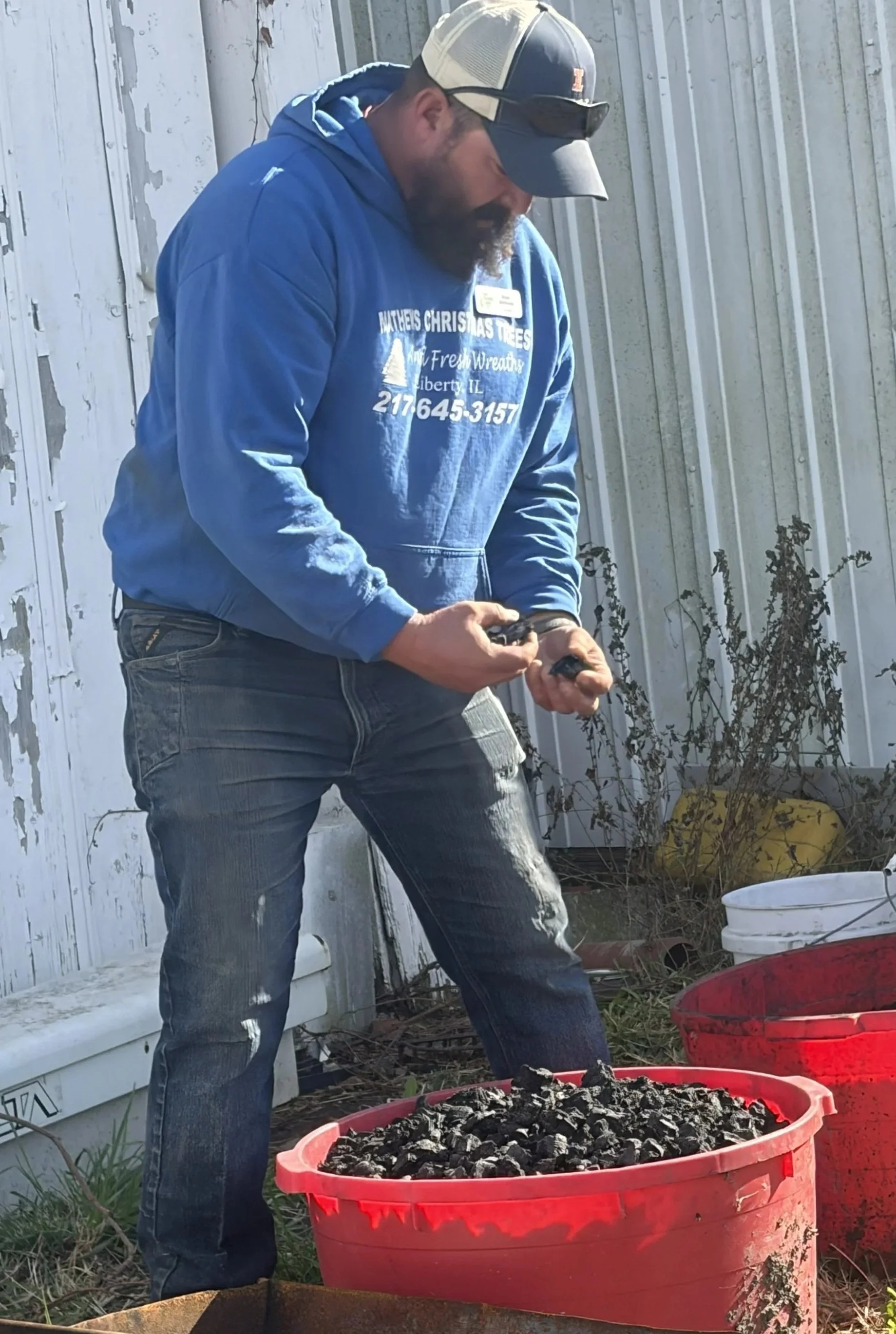
Brett Mathews discusses the process of making biochar with participants of the Illinois Grazing Lands Coalition pasture walk held in early November 2026. Image by Jacob Hamilton.
What are the potential benefits of biochar?
Biochar builds soil health by increasing soil’s capacity to hold water, reducing runoff, and increasing soil microorganism activity.
Biochar’s high cation exchange capacity improves the effects of fertilizer applications and acts as a nutrient reservoir, reducing the loss of potassium and magnesium. A high cation exchange means “soil has a strong ability to attract, hold, and exchange positively charged nutrients (cations) — such as calcium, magnesium, potassium, and ammonium — on negatively charged clay and organic matter surfaces,” says David B. Mengel, Purdue University Extension.
Research is ongoing on using biochar as a feed additive to improve animal gut health, nutrient absorption and growth performance. “Biochar has been linked to improved feed efficiency, leading to better weight gain and reduced feed costs,” says Mohsen Kazemi, National Institute of Health.
Biochar has been used for manure management. According to the American Biochar Institute, it can be mixed into bedding or applied to floors and feedlots to absorb moisture, improve aeration, extend bedding life, and cut odor emissions.
“Biochar has emerged as a promising strategy for mitigating gaseous emissions and reducing contaminant mobility during manure storage and composting processes.” (Department of Agricultural and Environmental Sciences, University of Milan)
Biochar effectively removes metal and organic contaminants from soil and water. It is an environmentally friendly alternative to coal-based activated-charcoal water filtration systems by binding to heavy metals and pollutants.
Biochar sequesters carbon that otherwise would be released as carbon dioxide, thus reducing the impact of harmful greenhouse gasses. The Intergovernmental Panel on Climate Change cites biochar as an affordable and market-ready solution to reducing emissions.
“It is predicted that at least 50% of the carbon in any piece of waste turned into biochar becomes stable, locking away that carbon for a period of several to hundreds of years, offsetting its contribution as a greenhouse gas in the form of carbon dioxide.”
Support for on-farm biochar system adoption
In 2022, the USDA Natural Resources Conservation Service established the 336 Soil Carbon Amendment. This program provides technical and funding to farmers who wish to increase carbon in their soils by adding amendments, including biochar.
Dig Deeper
What Is Biochar and How Is It Used?, Utah State University
What is Biochar, Illinois Sustainable Technology Center, Prairie Research Institute
Fundamentals of Soil Cation Exchange Capacity, David B. Mengel, Department of Agronomy, Purdue University Extension
Cation Exchange Capacity, Cornell University Extension
Removing Carbon, International Biochar Initiative
Digging into Biochar, USDA Climate Hubs
Biochar in Animal Agriculture: Enhancing Health, Efficiency and Environmental Sustainability, National Institute of Health
Biochar use in compost and manure management, American Biochar Institute
Read more about soil health

Biochar is a stable, carbon-rich material made by heating organic biomass in a low-oxygen environment, a process called pyrolysis.