“Farmland and solar farms often want the same things: flat, open, sun-drenched fields with access to the grid. Agrivoltaics offers a way to move past that either-or choice, by making it possible to harvest the sun twice, for food and for energy.”

There are two approaches to solar development on farmland, says Paul Mwebaze, University of Illinois Institute for Sustainability, Energy, and Environment (iSEE) visiting scholar.
Land sparing reserves the most productive farmland for crop production and places solar development on less productive land.
Land sharing co-locates agriculture and energy on the same land.
So, how does land sharing work, and why is this an opportunity for Illinois graziers?
Early University of Illinois research shows that combining row crops and solar energy production is not promising. Shady growing conditions and the loss of tillable ground to buffer areas reduce total crop production, Mwebaze says.
But, there is something that does work: grazing sheep under solar panels.
Establishing consistent vegetation is important on solar farms.
“We want good establishment of vegetation on site to avoid erosion concerns. But then we also don’t want the vegetation to get too high so that it’s shading the solar panels and we’re losing energy production.”
Vegetation may also wrap around and break equipment or become a fire hazard. That means that solar companies need someone (or some thing) to keep the vegetation from growing too tall.
The vegetation can be mechanically managed through mowing or naturally managed by grazing livestock.
Often, it takes both.
If livestock can’t keep pace with growth or if there is significant annual weed pressure, mechanical mowing is needed to supplement grazing, says Brooke Watson who owns a solar grazing and mowing business with her husband in DeKalb County. Most contracts obligate the grazier to also maintain exterior site property, including maintenance of trees and bushes.
For the past three grazing seasons, Brooke and Chauncy Watson have grazed 600 acres across 22 solar sites in 11 counties, including several urban counties. It’s important to remember what you’ve been hired to do, Brooke says.
“You’re being paid to provide vegetation management services,” Brooke explains. With proper grazing management, you can meet your vegetation management contract and let your sheep graze the free forage.
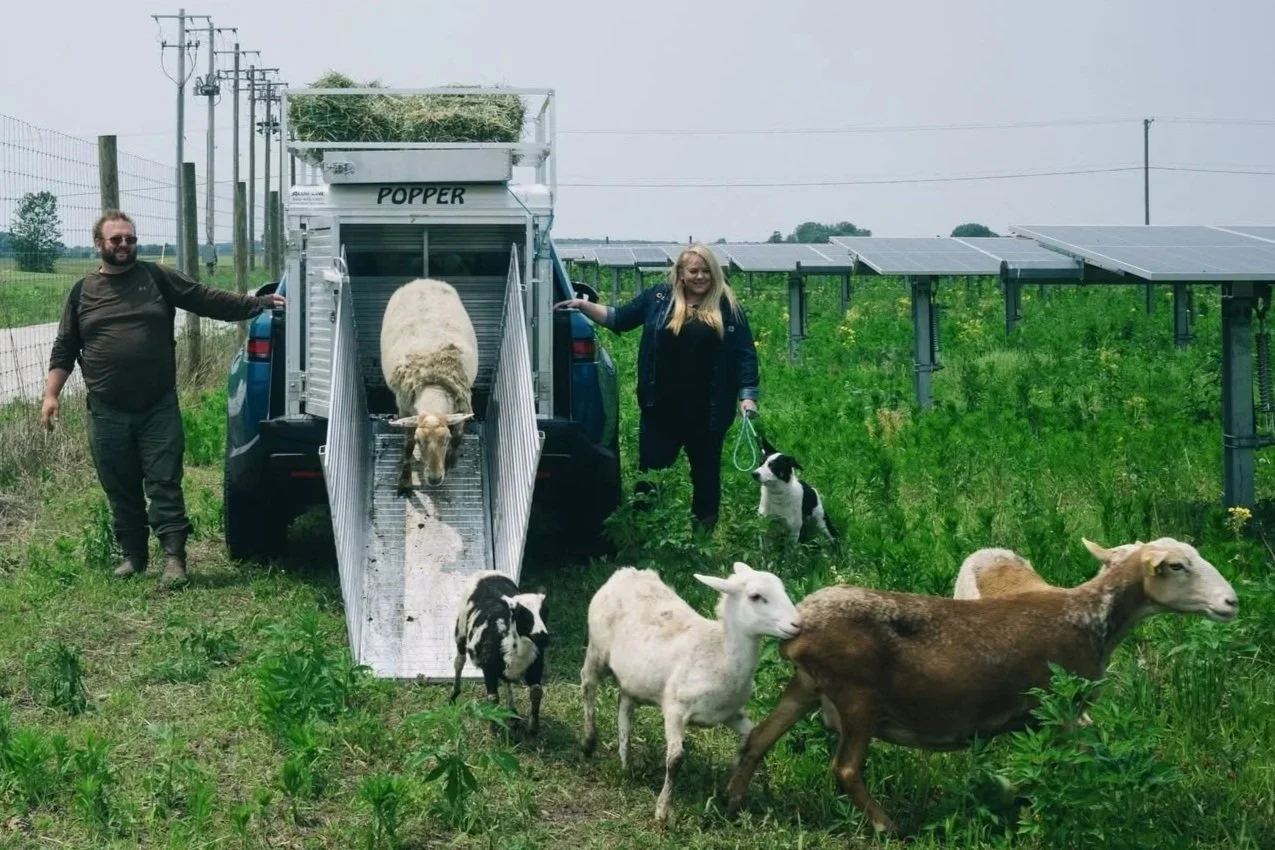
Farmers and solar graziers Brooke and Chauncey Watson unload sheep to graze at a solar site in Kankakee County, Illinois. Photo credit Rivian.
Illinois farmers can expect to be paid between $300 to $500 per acre for vegetation management services on solar energy fields.
"If we look at the sheep industry, this has been a real paradigm shift for them, where instead of having to pay to lease land to graze their animals — now they're actually getting paid to graze," said Austin Kinzer, an agrivoltaics specialist at the American Farmland Trust conservation movement.
Cattle can graze around panels, too, but sometimes panel height of earlier-built sites are too low for cattle.
Goats on solar have additional challenges; they tend to chew wires and climb on equipment, according to the American Solar Grazing Association, though goats can be useful for managing woody vegetation, brush, and fence lines which is also part of a vegetation management contract between a grazier and the solar company.
Do solar panels negatively impact animal health?
When built with grazing in mind, the impact to animal health and products is unaffected by animals grazing within solar farms. The Watsons have seen no negative impact on flock health.
There is no fear of toxic chemicals leaching into the soil or consumed by the livestock, Brooke says, noting that panel technology has advanced to eliminate any safety issues for animals or humans who consume that meat.
There are challenges that need good management. Sheep can become entangled in panel wires if developers don’t adequately plan for potential livestock grazing. Inadequate perimeter fencing can leave animals vulnerable to predators.
The vegetation is rarely what graziers would choose for their perfect pasture mixtures, unless you contract with developers from the ground level.
“It’d be beautiful if everything was orchard grass and red clover,” Chauncey laughs, “but that’s just not going to happen.”
So far, the ewes have thrived.
“They are very, very, very happy,” Chauncey says. “They have shade and they have wonderful feed. They never come off the solar pastures thin.”
Is solar grazing in your future?
Farmland can remain agriculturally productive and co-exist with solar production, especially when the vegetation is used for livestock grazing. In many instances, with the right ag production and the right infrastructure, agriculture and photovoltaics (the production of energy from the sun) can both exist in a shared space.
“I do think it’s very important we produce food on this land. It really needs to have some sort of agricultural production on it still for me to really think it’s a good idea.”
For more information
To help farmers understand the challenges and rewards of solar grazing, Brooke founded the Illinois Agrivoltaics Network to facilitate conversations about the benefits of agriculture and solar collaborations. Farmers can contact her through the farm’s website. The American Solar Grazing Association works directly with graziers interested in collaborating with solar energy companies.
You may also enjoy these blogs on solar grazing
Sheep: A sustainable answer to managing solar vegetation, The Brooke and Chauncey Watson story, The Grazing and Forage Hub
Grazing helps boost soil biology under solar panels, The Grazing and Forage Hub
Dig Deeper
Sheep: A sustainable answer to managing solar vegetation, The Grazing and Forage Hub
Exploring Solar Impacts on Soil Health Resilient Communities, University of Illinois Extension (Val Stori, Michael Ricketts)
Navigating Local Land Use, Conservation, and Farm Economics, University of Illinois Extension (Andrea Wagner, Claire Shipp, Paul Mwebaze)
Grazing Between the Panels: How Sheep Are Expanding What’s Possible for Solar and Agriculture in Massachusetts, American Farmland Trust
Policy Recommendations to Increase Agrivoltaic Development, American Farmland Trust
Illinois Solar and Agriculture, Clean Grid Alliance
Solar Farms in Illinois, Cleanview
Solar Energy Industries Association, Illinois Sites
Shared space: $10 million grant examines how crops, solar can occupy same space, Illinois Extension
New U of I research explores how solar energy and production ag can cohabitate, thrive, FarmWeek Now
USDA funds 'agrivoltaics' project led by iSEE and UIUC researchers, including Miljkovic, University of Illinois Grainger College of Engineering
Illinois farmers find that sheep and solar arrays go well together, Canary Media
There's a solar boom in rural America. Can agriculture and renewable energy share the land?, NPR Illinois
Goats Gone Wild, American Solar Grazing Association
Illinois Solar Grazing & Mowing, Brooke and Chauncey Watson